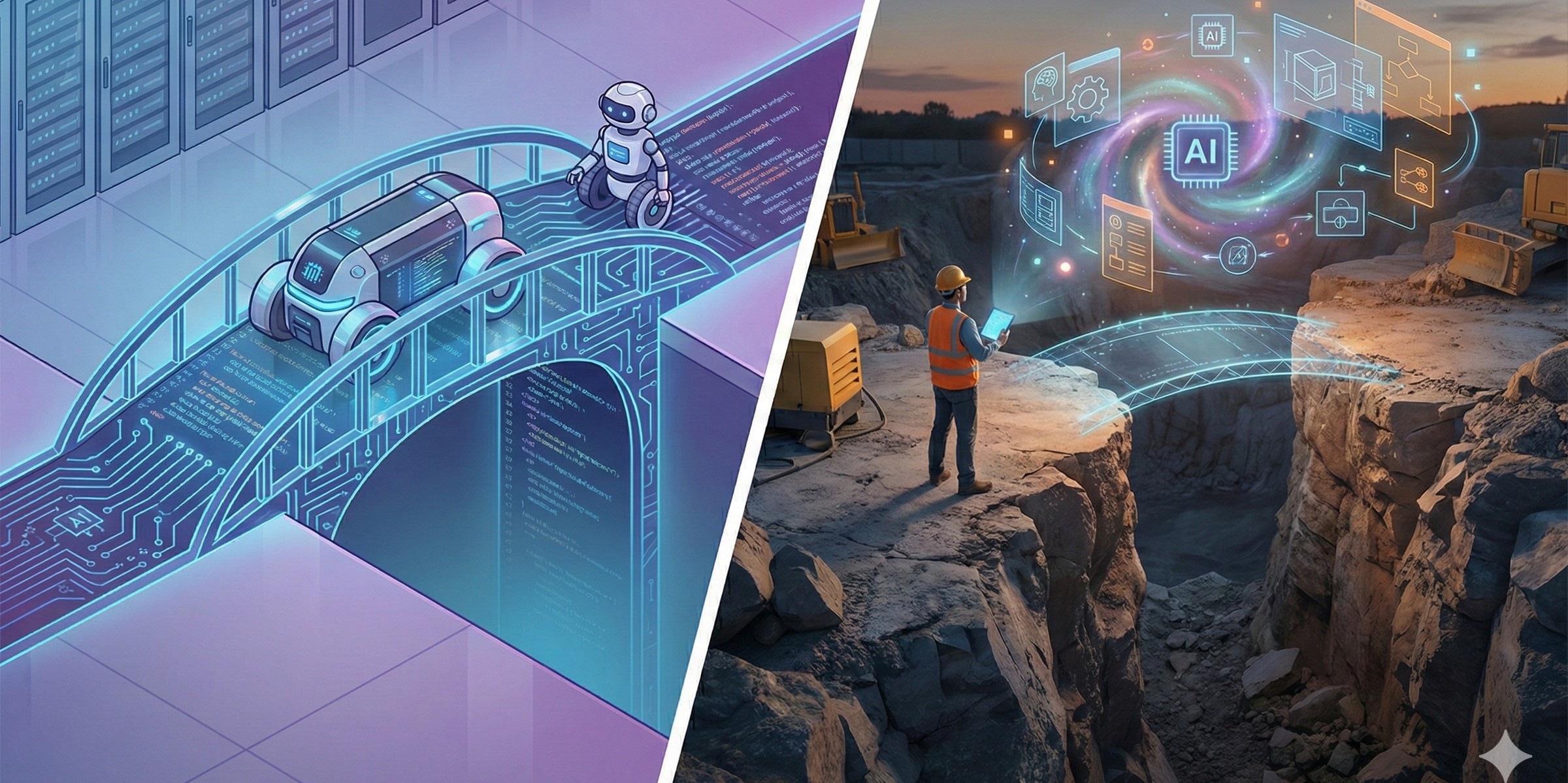
For the better part of fifteen years, the startup playbook has been built on a single premise: software companies disrupt legacy industries by doing the same things more efficiently. This is the core of the "software is eating the world" thesis that has defined venture capital since Marc Andreessen wrote those words in 2011. Tech companies move into traditional sectors, extract better margins through software leverage, and the incumbents either adapt or die.
That playbook has always had a mixed track record. Sometimes it worked brilliantly. Sometimes it burned billions of dollars proving that technology alone can't replace operational expertise. But either way, the underlying logic depended on a structural advantage: software companies had engineering capacity and traditional businesses didn't.
AI has eliminated that advantage. The cost of building software has collapsed, and you no longer need engineers to do it. But that shift doesn't automatically hand the keys to traditional operators. Most of them wouldn't have known how to direct a team of engineers even if they'd had one. The new bottleneck isn't access to engineering. It's the ability to combine deep operational knowledge with product development instinct, to understand both how a business runs and how to translate that understanding into software. That cross-functional skill set is rare, and it's becoming the most valuable capability in the market. What follows is a look at why the old model broke, what's replaced it, and where the opportunity sits for operators, software companies, and investors who can see the shift.
The "software eating the world" thesis was never wrong in principle. It was wrong in application about half the time, and the difference between success and failure comes down to a specific question: are you replacing an antiquated process, or are you trying to replace human judgment in a complex operating environment?
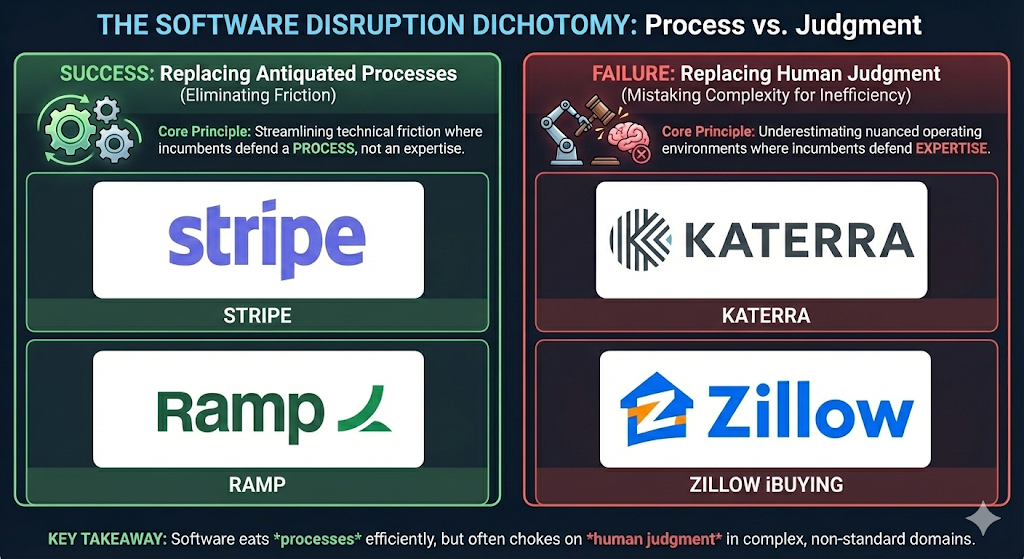
When the answer is the former, technology-first outsiders have built some of the most valuable companies of the last decade. Stripe replaced a genuinely broken payments infrastructure. Before Stripe, integrating payment processing into a product meant weeks of work with clunky gateway APIs, merchant account applications, and painful compliance hurdles. Stripe made it a few lines of code. The old process was purely technical friction with no redeeming complexity, and software eliminated it cleanly. Ramp attacked corporate expense management the same way. Legacy corporate card programs from the major issuers were built around manual reconciliation, paper receipts, and month-end close processes that hadn't materially changed in decades. Ramp replaced the entire workflow with automated categorization, real-time spend controls, and integrated accounting. The old way wasn't complex. It was just outdated. Shopify did the same thing for small business e-commerce, and Square did it for point-of-sale. In each case, the disruption succeeded because the incumbents were defending a process, not an expertise.
The failures happen when technology companies mistake operational complexity for technical inefficiency. Katerra raised over $2 billion from SoftBank to vertically integrate construction, from design through manufacturing to on-site assembly. The founding team came from electronics and tech investing, not construction. They burned nearly $1 million a day for six years before going bankrupt, because building a house is not a process problem you can engineer away from the outside. Zillow's iBuying program bet that its Zestimate algorithm could replace local market judgment when pricing homes. It wrote down over $500 million and laid off a quarter of its workforce when the algorithm kept overvaluing properties that any experienced local broker would have priced correctly.
The distinction matters because most of the traditional economy falls into the second category. The businesses that run logistics, construction, facilities management, skilled trades, and local services are operationally complex in ways that don't compress into elegant software abstractions. They require judgment, relationships, and an understanding of physical reality that technology alone has never been able to replicate.
But that doesn't mean technology can't transform them. It just means the transformation has to come from the inside.
Compass is the most instructive example of this dynamic because it lived through both sides of it.
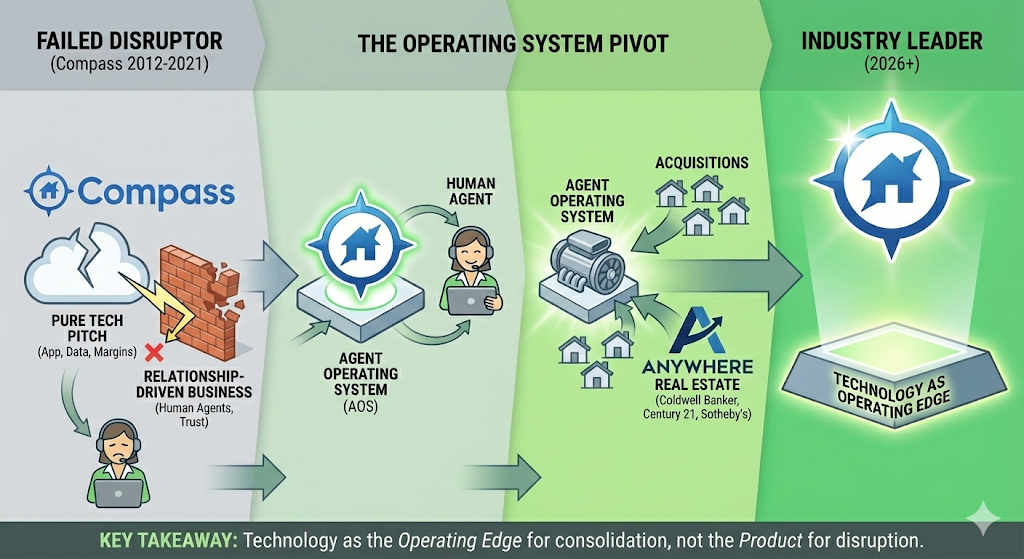
When Compass launched in 2012, the pitch was pure disruption. Technology-enabled brokerage. Better tools, better data, better margins. The company raised over $1.5 billion and went public in 2021 at an $8 billion valuation on the promise that it could turn residential real estate into a technology business. But real estate brokerage turned out to be one of those operationally complex industries. Homebuyers still chose agents based on personal relationships. Agents still split commissions the same way they always had. Compass wasn't replacing a broken process. It was layering technology onto a relationship-driven business where the technology wasn't the bottleneck.
What happened next is the interesting part. Rather than continuing to pretend it was a pure tech company, Compass evolved. It built what it calls the Agent Operating System, a suite of integrated tools covering CRM, marketing automation, transaction management, and lead routing, designed around how agents actually work. Not software as the product, but software as the operating backbone of the brokerage itself. That internal operating system became the foundation for something much bigger: a roll-up strategy.
Compass started acquiring high-performing independent brokerages across the country, integrating them onto its technology platform, and creating operational efficiencies that traditional brokerages couldn't match. In September 2025, Compass announced a $1.6 billion acquisition of Anywhere Real Estate, the parent company of Coldwell Banker, Century 21, and Sotheby's International Realty. The deal closed in January 2026, creating a 340,000-agent network and the largest residential brokerage in the world.
The trajectory is striking. Compass started by saying it would disrupt real estate from the outside with software. That didn't work. So it built an internal operating system around deep understanding of how the business actually runs, then used that operating system as the engine for a consolidation strategy that has fundamentally reshaped the industry. It went from failed disruptor to the most consequential operator in its sector in about a decade, and the technology was what made the roll-up economics work. Not technology as the product. Technology as the operating edge.
That arc is exactly the opportunity we see opening up across dozens of traditional industries right now. And AI is about to make it dramatically more accessible.
The structural advantage of a technology company over a traditional business has always been engineering capacity. A software company has engineers embedded across the entire organization. The business itself is an engineering organization. A traditional business, by contrast, might have a small IT team keeping the lights on, with no capacity to build custom tools, automate workflows, or develop software products.
That gap is gone. Every business now has access to essentially unlimited engineering capacity through AI automation and agentic coding tools. Claude Code with Opus 4.6 and Codex with GPT-5.3, and a growing list of others, mean that a warehouse operator, a construction company, or a regional logistics firm can build and deploy functional software without hiring a single engineer. The cost of building discrete software tools has collapsed from hundreds of thousands of dollars and months of development time to an afternoon and a weekend.

This is a massive shift. The competitive moat of "we have engineers and you don't" no longer separates tech companies from everyone else.
But a new gap has opened up, and it may be even more consequential than the old one.
If every business now has engineering capacity on demand, the question becomes: do you know what to build? Do you have the product instinct and domain expertise to deploy these tools in ways that actually move the needle? The bottleneck has shifted from "can we build it" to "do we know what to build and how to think about it."
This is where operators with deep vertical expertise become the most valuable people in the room. Someone who has spent twenty years running warehouse operations understands the pain points, the workflows, the edge cases, and the places where even small efficiency gains create meaningful cash flow improvements. They know where the leverage is. What they often lack is an understanding of how to orchestrate AI agents as replacements for traditional engineering teams, or even awareness of what's now possible.
The interface is still evolving. Knowing how to instruct and direct AI tools to build what you need requires a product mindset that most traditional operators have not yet developed. It's a learnable skill, but right now, the people who have both domain knowledge and the ability to think like a product builder are incredibly rare. That's the operator gap.
There's a useful parallel in how technology adoption played out across developing economies. In much of Asia and India, entire populations skipped the desktop computer entirely and went straight to mobile. They never had the intermediate step. As a result, they became mobile-first connected societies faster than we did in the West, building infrastructure and business models around mobile from day one rather than retrofitting desktop-era systems.
The same dynamic is playing out now in traditional industries. A business that has operated on pen and paper, with zero technology throughout its entire operation, doesn't need to go through fifteen years of SaaS adoption, cloud migration, and digital transformation consulting. It can go straight from nothing to deeply integrated, AI-built software tools in a matter of weeks.
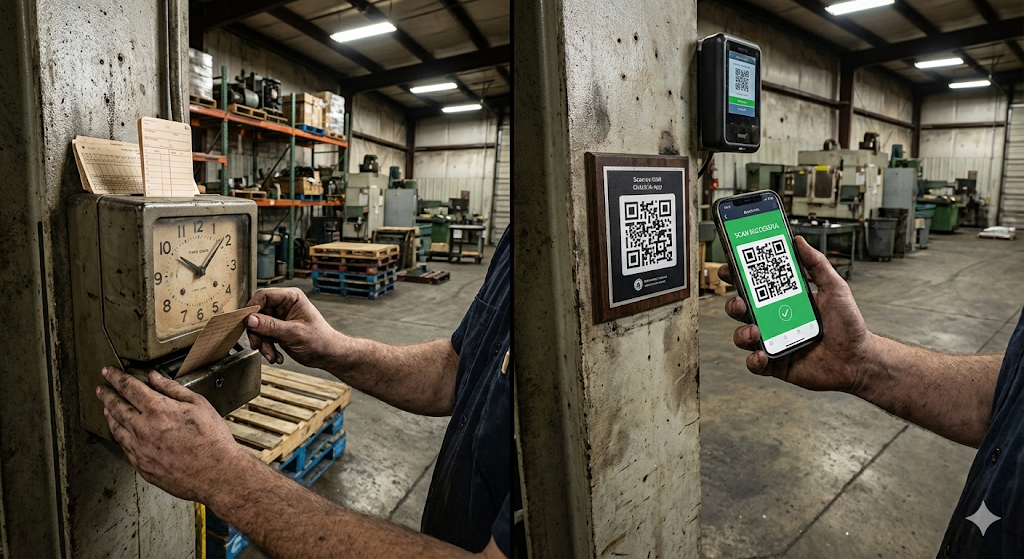
The reason this works is simple: the workforce already has the hardware. Everyone carries a mobile phone. They use technology in their personal lives every day. If you build an inventory scanning app that runs on a warehouse worker's phone using QR codes, you don't need to train anyone on how to use a phone. You just need to build the app. And building that app, which would have cost six figures and taken months not long ago, can now happen in a weekend.
The operators and advisors who figure this out first will have a compounding advantage that becomes increasingly difficult to replicate with each passing month.
Every piece of software-driven leverage you build into a traditional business creates real cash flow. That cash flow creates options. You can offer the same products or services at lower prices while maintaining your margin, which puts pressure on competitors still running on pen and paper. Or you can use that cash flow as an acquisition tool, rolling up peers in your sector and migrating them onto the operating stack you've already built. On day one of an acquisition, you're creating value by deploying technology the acquired business never had access to. This is the Compass playbook at a smaller scale, and the economics have gotten dramatically more attractive now that the cost of building the technology stack is a fraction of what Compass spent.
This shift also creates an interesting strategic path for a category of software companies that are increasingly stuck.
Consider a vertical SaaS business doing $1 to $5 million in revenue. Good product, real customers, strong retention. But the Series A market has gotten brutally selective. Unless you can credibly pitch a path from $5 million to $50 million in the next 18 months, institutional capital isn't interested. These are perfectly good businesses that the current fundraising environment treats as uninvestable.
But what if the answer isn't raising more equity capital? What if the answer is becoming the acquirer?
A vertical SaaS company already has deep visibility into a fragmented customer base. It knows which businesses are using the product well, which ones are growing, and which sectors have the kind of sticky local relationships and physical operations that make them structurally sound. That's an intelligence advantage most PE roll-up shops would kill for. The software company has essentially been running diligence on its own customers for years.
The playbook goes like this. Instead of trying to sell a $500-per-month subscription to every plumbing company, landscaping firm, or regional logistics operator in your market, you buy the service business itself. You migrate it fully onto your operating system on day one. Every efficiency gain you've been offering through your software, the margin improvement, the workflow automation, the data-driven decision-making, you now capture 100% of that value creation instead of charging a small monthly fee for it. That margin expansion or multiple expansion funds the next acquisition. And the one after that.
The software doesn't have to be your revenue model. It can be your sourcing mechanism and your operating edge. You know exactly which businesses in your customer base would benefit most from full technology integration, because you already have the data. You know their operations, their growth trajectory, their willingness to adopt new tools. That's a roll-up thesis with built-in deal flow and a technology deployment advantage that a traditional acquirer simply can't replicate.
For software founders who have been banging their heads against a fundraising wall, this reframe could be transformative. You stop competing for a shrinking pool of venture dollars and start competing in a market where your technology gives you a structural edge no one else has.
The opportunity is not uniform across all traditional industries. The most interesting targets are sectors that either benefit from AI tailwinds or are structurally insulated from direct AI disruption. A business that involves physical operations, local relationships, regulatory complexity, or real-world logistics has inherent defensibility that a purely digital business lacks. AI can make these businesses dramatically more efficient without threatening to replace them entirely.
The least interesting targets are businesses in sectors where AI itself can displace the core value proposition. If the primary service you provide is something an AI agent can do directly for the end customer, the moat you're building is temporary at best.
We are in the very early innings of this transition. The capabilities are immense, but the awareness gap is still wide. Most operators of traditional businesses don't know where to start, and many don't yet realize what's become possible.
The "software eating the world" era created trillions of dollars in value by building software companies that sold tools to traditional industries. But the track record of those companies actually conquering those industries is far more nuanced than the narrative suggests. When the target was a broken process, technology-first companies won decisively. When the target was a complex operating environment, capital and code alone were insufficient.
What's changed is that the cost of building technology has collapsed to near zero, and you no longer need engineers to build it. You direct AI agents instead. But here's the subtlety that most people miss: collapsing the cost of engineering doesn't automatically hand the advantage to traditional operators. Most operators of traditional businesses wouldn't have known how to use a team of engineers even if they'd had one. They don't think in terms of product specifications, user workflows, or system architecture. They know their business inside and out, but they've never had to translate that knowledge into a software buildout.
The most valuable skill set right now is the ability to do both. Someone who understands the internal operations of a business deeply enough to know where the leverage is, and who also knows how to construct software applications, to define what needs to be built, scope the product, and direct the build process. That used to mean managing engineering teams. Now it means directing AI agents. But the product thinking is the same, and it's rare.
The next wave of value creation in traditional industries won't come from software companies disrupting from the outside. It will come from people who can bridge operational expertise and product development, embedding technology from within. And for the software companies already serving those industries, the most interesting move might not be raising the next round. It might be becoming the operator and using the tools as the edge.

For the better part of fifteen years, the startup playbook has been built on a single premise: software companies disrupt legacy industries by doing the same things more efficiently. This is the core of the "software is eating the world" thesis that has defined venture capital since Marc Andreessen wrote those words in 2011. Tech companies move into traditional sectors, extract better margins through software leverage, and the incumbents either adapt or die.
That playbook has always had a mixed track record. Sometimes it worked brilliantly. Sometimes it burned billions of dollars proving that technology alone can't replace operational expertise. But either way, the underlying logic depended on a structural advantage: software companies had engineering capacity and traditional businesses didn't.
AI has eliminated that advantage. The cost of building software has collapsed, and you no longer need engineers to do it. But that shift doesn't automatically hand the keys to traditional operators. Most of them wouldn't have known how to direct a team of engineers even if they'd had one. The new bottleneck isn't access to engineering. It's the ability to combine deep operational knowledge with product development instinct, to understand both how a business runs and how to translate that understanding into software. That cross-functional skill set is rare, and it's becoming the most valuable capability in the market. What follows is a look at why the old model broke, what's replaced it, and where the opportunity sits for operators, software companies, and investors who can see the shift.
The "software eating the world" thesis was never wrong in principle. It was wrong in application about half the time, and the difference between success and failure comes down to a specific question: are you replacing an antiquated process, or are you trying to replace human judgment in a complex operating environment?

When the answer is the former, technology-first outsiders have built some of the most valuable companies of the last decade. Stripe replaced a genuinely broken payments infrastructure. Before Stripe, integrating payment processing into a product meant weeks of work with clunky gateway APIs, merchant account applications, and painful compliance hurdles. Stripe made it a few lines of code. The old process was purely technical friction with no redeeming complexity, and software eliminated it cleanly. Ramp attacked corporate expense management the same way. Legacy corporate card programs from the major issuers were built around manual reconciliation, paper receipts, and month-end close processes that hadn't materially changed in decades. Ramp replaced the entire workflow with automated categorization, real-time spend controls, and integrated accounting. The old way wasn't complex. It was just outdated. Shopify did the same thing for small business e-commerce, and Square did it for point-of-sale. In each case, the disruption succeeded because the incumbents were defending a process, not an expertise.
The failures happen when technology companies mistake operational complexity for technical inefficiency. Katerra raised over $2 billion from SoftBank to vertically integrate construction, from design through manufacturing to on-site assembly. The founding team came from electronics and tech investing, not construction. They burned nearly $1 million a day for six years before going bankrupt, because building a house is not a process problem you can engineer away from the outside. Zillow's iBuying program bet that its Zestimate algorithm could replace local market judgment when pricing homes. It wrote down over $500 million and laid off a quarter of its workforce when the algorithm kept overvaluing properties that any experienced local broker would have priced correctly.
The distinction matters because most of the traditional economy falls into the second category. The businesses that run logistics, construction, facilities management, skilled trades, and local services are operationally complex in ways that don't compress into elegant software abstractions. They require judgment, relationships, and an understanding of physical reality that technology alone has never been able to replicate.
But that doesn't mean technology can't transform them. It just means the transformation has to come from the inside.
Compass is the most instructive example of this dynamic because it lived through both sides of it.

When Compass launched in 2012, the pitch was pure disruption. Technology-enabled brokerage. Better tools, better data, better margins. The company raised over $1.5 billion and went public in 2021 at an $8 billion valuation on the promise that it could turn residential real estate into a technology business. But real estate brokerage turned out to be one of those operationally complex industries. Homebuyers still chose agents based on personal relationships. Agents still split commissions the same way they always had. Compass wasn't replacing a broken process. It was layering technology onto a relationship-driven business where the technology wasn't the bottleneck.
What happened next is the interesting part. Rather than continuing to pretend it was a pure tech company, Compass evolved. It built what it calls the Agent Operating System, a suite of integrated tools covering CRM, marketing automation, transaction management, and lead routing, designed around how agents actually work. Not software as the product, but software as the operating backbone of the brokerage itself. That internal operating system became the foundation for something much bigger: a roll-up strategy.
Compass started acquiring high-performing independent brokerages across the country, integrating them onto its technology platform, and creating operational efficiencies that traditional brokerages couldn't match. In September 2025, Compass announced a $1.6 billion acquisition of Anywhere Real Estate, the parent company of Coldwell Banker, Century 21, and Sotheby's International Realty. The deal closed in January 2026, creating a 340,000-agent network and the largest residential brokerage in the world.
The trajectory is striking. Compass started by saying it would disrupt real estate from the outside with software. That didn't work. So it built an internal operating system around deep understanding of how the business actually runs, then used that operating system as the engine for a consolidation strategy that has fundamentally reshaped the industry. It went from failed disruptor to the most consequential operator in its sector in about a decade, and the technology was what made the roll-up economics work. Not technology as the product. Technology as the operating edge.
That arc is exactly the opportunity we see opening up across dozens of traditional industries right now. And AI is about to make it dramatically more accessible.
The structural advantage of a technology company over a traditional business has always been engineering capacity. A software company has engineers embedded across the entire organization. The business itself is an engineering organization. A traditional business, by contrast, might have a small IT team keeping the lights on, with no capacity to build custom tools, automate workflows, or develop software products.
That gap is gone. Every business now has access to essentially unlimited engineering capacity through AI automation and agentic coding tools. Claude Code with Opus 4.6 and Codex with GPT-5.3, and a growing list of others, mean that a warehouse operator, a construction company, or a regional logistics firm can build and deploy functional software without hiring a single engineer. The cost of building discrete software tools has collapsed from hundreds of thousands of dollars and months of development time to an afternoon and a weekend.

This is a massive shift. The competitive moat of "we have engineers and you don't" no longer separates tech companies from everyone else.
But a new gap has opened up, and it may be even more consequential than the old one.
If every business now has engineering capacity on demand, the question becomes: do you know what to build? Do you have the product instinct and domain expertise to deploy these tools in ways that actually move the needle? The bottleneck has shifted from "can we build it" to "do we know what to build and how to think about it."
This is where operators with deep vertical expertise become the most valuable people in the room. Someone who has spent twenty years running warehouse operations understands the pain points, the workflows, the edge cases, and the places where even small efficiency gains create meaningful cash flow improvements. They know where the leverage is. What they often lack is an understanding of how to orchestrate AI agents as replacements for traditional engineering teams, or even awareness of what's now possible.
The interface is still evolving. Knowing how to instruct and direct AI tools to build what you need requires a product mindset that most traditional operators have not yet developed. It's a learnable skill, but right now, the people who have both domain knowledge and the ability to think like a product builder are incredibly rare. That's the operator gap.
There's a useful parallel in how technology adoption played out across developing economies. In much of Asia and India, entire populations skipped the desktop computer entirely and went straight to mobile. They never had the intermediate step. As a result, they became mobile-first connected societies faster than we did in the West, building infrastructure and business models around mobile from day one rather than retrofitting desktop-era systems.
The same dynamic is playing out now in traditional industries. A business that has operated on pen and paper, with zero technology throughout its entire operation, doesn't need to go through fifteen years of SaaS adoption, cloud migration, and digital transformation consulting. It can go straight from nothing to deeply integrated, AI-built software tools in a matter of weeks.

The reason this works is simple: the workforce already has the hardware. Everyone carries a mobile phone. They use technology in their personal lives every day. If you build an inventory scanning app that runs on a warehouse worker's phone using QR codes, you don't need to train anyone on how to use a phone. You just need to build the app. And building that app, which would have cost six figures and taken months not long ago, can now happen in a weekend.
The operators and advisors who figure this out first will have a compounding advantage that becomes increasingly difficult to replicate with each passing month.
Every piece of software-driven leverage you build into a traditional business creates real cash flow. That cash flow creates options. You can offer the same products or services at lower prices while maintaining your margin, which puts pressure on competitors still running on pen and paper. Or you can use that cash flow as an acquisition tool, rolling up peers in your sector and migrating them onto the operating stack you've already built. On day one of an acquisition, you're creating value by deploying technology the acquired business never had access to. This is the Compass playbook at a smaller scale, and the economics have gotten dramatically more attractive now that the cost of building the technology stack is a fraction of what Compass spent.
This shift also creates an interesting strategic path for a category of software companies that are increasingly stuck.
Consider a vertical SaaS business doing $1 to $5 million in revenue. Good product, real customers, strong retention. But the Series A market has gotten brutally selective. Unless you can credibly pitch a path from $5 million to $50 million in the next 18 months, institutional capital isn't interested. These are perfectly good businesses that the current fundraising environment treats as uninvestable.
But what if the answer isn't raising more equity capital? What if the answer is becoming the acquirer?
A vertical SaaS company already has deep visibility into a fragmented customer base. It knows which businesses are using the product well, which ones are growing, and which sectors have the kind of sticky local relationships and physical operations that make them structurally sound. That's an intelligence advantage most PE roll-up shops would kill for. The software company has essentially been running diligence on its own customers for years.
The playbook goes like this. Instead of trying to sell a $500-per-month subscription to every plumbing company, landscaping firm, or regional logistics operator in your market, you buy the service business itself. You migrate it fully onto your operating system on day one. Every efficiency gain you've been offering through your software, the margin improvement, the workflow automation, the data-driven decision-making, you now capture 100% of that value creation instead of charging a small monthly fee for it. That margin expansion or multiple expansion funds the next acquisition. And the one after that.
The software doesn't have to be your revenue model. It can be your sourcing mechanism and your operating edge. You know exactly which businesses in your customer base would benefit most from full technology integration, because you already have the data. You know their operations, their growth trajectory, their willingness to adopt new tools. That's a roll-up thesis with built-in deal flow and a technology deployment advantage that a traditional acquirer simply can't replicate.
For software founders who have been banging their heads against a fundraising wall, this reframe could be transformative. You stop competing for a shrinking pool of venture dollars and start competing in a market where your technology gives you a structural edge no one else has.
The opportunity is not uniform across all traditional industries. The most interesting targets are sectors that either benefit from AI tailwinds or are structurally insulated from direct AI disruption. A business that involves physical operations, local relationships, regulatory complexity, or real-world logistics has inherent defensibility that a purely digital business lacks. AI can make these businesses dramatically more efficient without threatening to replace them entirely.
The least interesting targets are businesses in sectors where AI itself can displace the core value proposition. If the primary service you provide is something an AI agent can do directly for the end customer, the moat you're building is temporary at best.
We are in the very early innings of this transition. The capabilities are immense, but the awareness gap is still wide. Most operators of traditional businesses don't know where to start, and many don't yet realize what's become possible.
The "software eating the world" era created trillions of dollars in value by building software companies that sold tools to traditional industries. But the track record of those companies actually conquering those industries is far more nuanced than the narrative suggests. When the target was a broken process, technology-first companies won decisively. When the target was a complex operating environment, capital and code alone were insufficient.
What's changed is that the cost of building technology has collapsed to near zero, and you no longer need engineers to build it. You direct AI agents instead. But here's the subtlety that most people miss: collapsing the cost of engineering doesn't automatically hand the advantage to traditional operators. Most operators of traditional businesses wouldn't have known how to use a team of engineers even if they'd had one. They don't think in terms of product specifications, user workflows, or system architecture. They know their business inside and out, but they've never had to translate that knowledge into a software buildout.
The most valuable skill set right now is the ability to do both. Someone who understands the internal operations of a business deeply enough to know where the leverage is, and who also knows how to construct software applications, to define what needs to be built, scope the product, and direct the build process. That used to mean managing engineering teams. Now it means directing AI agents. But the product thinking is the same, and it's rare.
The next wave of value creation in traditional industries won't come from software companies disrupting from the outside. It will come from people who can bridge operational expertise and product development, embedding technology from within. And for the software companies already serving those industries, the most interesting move might not be raising the next round. It might be becoming the operator and using the tools as the edge.
Announcing the launch of Factor Capital

Yes People Want Crypto Apps
Just not the ones crypto people want - why practical solutions beat ideology and how porn might be the solution.

The AI Interface to Web3
AI Agents are already showing mainstream adoption and impact in enterprise applications. The consumer impact could be even larger as it onboards the masses to web3.
Announcing the launch of Factor Capital

Yes People Want Crypto Apps
Just not the ones crypto people want - why practical solutions beat ideology and how porn might be the solution.

The AI Interface to Web3
AI Agents are already showing mainstream adoption and impact in enterprise applications. The consumer impact could be even larger as it onboards the masses to web3.
>700 subscribers
>700 subscribers
Share Dialog
Share Dialog
No comments yet